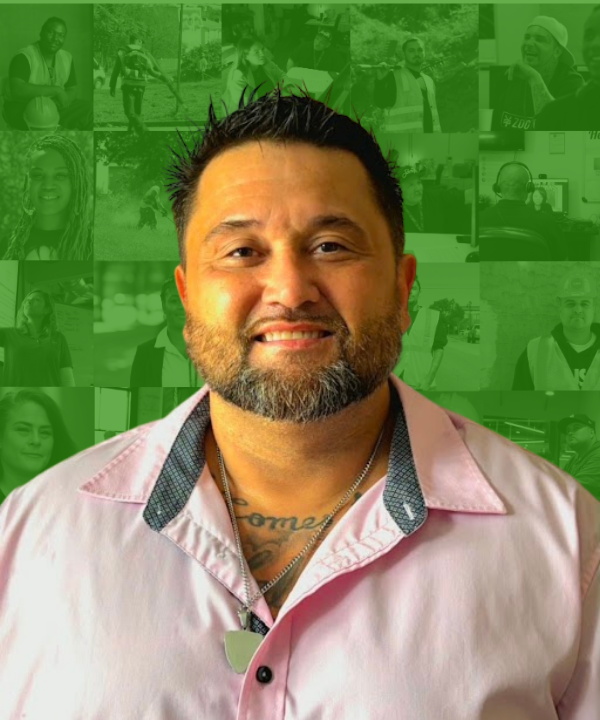
Talking to Jeremy, one of the first things he will share is how proud he is of his daughter, and his joy for her blossoming career as a wrestler with aspirations of making her way to the WWE. He is proud that he is able to provide for his kids, grandchildren, has a beautiful apartment and the 401K he always imagined. What is harder to imagine is that this joyful, grateful man spent a good chunk of adulthood incarcerated. With his final bid he made a choice to dedicate over a year to his mental health and self improvement in an intensive cognitive behavioral therapy program and halfway house before feeling ready to be the best man he could be and return to his family. Today, he considers it a privilege to stay current on his child support, but even more so to be an active, present force in the lives of his children and grandchildren.
“I’d rather be broke and have all the essential things, than a pocket full of money and not the things I will need tomorrow.”
Growing up, Jeremy experienced firsthand what it meant to be in need of support. He recalls a childhood marked by violence, describing his mother as a functional addict and his stepfather as abusive. Despite these challenges, he remembers a family that still tried to maintain a sense of normalcy: parents working regular jobs, chores posted on the refrigerator, and family dinners every night. However, those same dinners often became the source of adverse childhood experiences that frequently lead individuals toward incarceration. Recognizing his athletic potential, his family enrolled him in a school specifically designed for aspiring young athletes.
As it turned out, he was exceptional.
In high school, Jeremy didn’t just dream of being a famous baseball player; he prepared for it. He remembers being considered one of the top shortstops in the area and being able to play nearly any position. His ability was enough that baseball was his sure path to college, and it was acceptance to a specialty program that would help him get there. His family lived close to the school for this specific reason, hoping his future would be better than what he experienced at home.
But, coaches were warning Jeremy that the trouble he was getting into could derail those opportunities. Ultimately, it wasn't his juvenile record that ended his pursuit of baseball. It was an injury.
Without the sport that had provided an outlet and a possible future, Jeremy began moving further off track. By around 17, he had entered a cycle of incarceration and supervision that would follow him for more than two decades.
Jeremy estimates spending about 14 years in the system. He says he rarely got into trouble while incarcerated and always intended to do better when he came home.
“I always thought I was going to do better,” he said.
But each time, he eventually found himself returning to old behaviors, thanks to the childhood that made fighting normal.
But his mindset began to change during his most recent experience.
Facing the possibility of six years in prison if he failed, Jeremy was given an opportunity to enter an intensive behavioral program. The work was difficult enough that, according to Jeremy, some participants chose to leave the program and serve their prison sentences instead.
Jeremy stayed.
“I actually wanted to change my life,” he said. “I'm tired. I don't want this. Like, that's not what I want anymore.”
After completing the program, Jeremy made another important decision. Rather than immediately returning home, he voluntarily entered a sober-living facility away from his hometown. His probation officer told him the additional step wasn't required.
Jeremy knew it wasn't.
“I could have gone home, been free, and ran the streets, and probably been back,” he said. “But I wasn't ready, and I knew I wasn't ready.”
The structured environment gave Jeremy time. He continued working on himself while also working for pay. He regained his driver's license after decades without one, bought a car, worked on barges along the Ohio River and saved money. He remained in structured housing until he felt financially comfortable leaving, then moved into an apartment closer to his children and grandchildren.
That access to stable transitional housing is not a small part of Jeremy's story.
National research has found that formerly incarcerated people experience homelessness at nearly 10 times the rate of the general population. The risk is even greater for people who have experienced repeated incarceration—the same revolving door Jeremy spent much of his adult life trying to escape.
Jeremy's experience demonstrates what that period between incarceration and complete independence can make possible. A person leaving incarceration may need more than the determination not to return. There must also be somewhere for that determination to go.
For Jeremy, structured housing created space to continue treatment, work, save money and prepare for independent living before returning closer to home.
“It's me,” Jeremy said of what ultimately had to change. “I had to change me before I can change anything in my life.”
Once closer to his family, however, another familiar reentry barrier emerged: employment.
Jeremy would briefly find work here and there, picking up odd jobs doing concrete, flooring and other labor, but he wanted something more stable.
“I need to find a job where I can, you know, start a 401(k),” he remembered thinking.
While searching online for employment assistance for people with felony records, Jeremy found the Center for Employment Opportunities (CEO) in Columbus.
Once enrolled, Jeremy completed orientation and safety training before joining a CEO work crew. He remembers working outside in freezing weather picking up debris along roadsides for modest daily pay.
“I was humbling myself,” he said.
The work provided immediate income while also giving Jeremy an opportunity to demonstrate that he could consistently show up and work. CEO remained available for employment support while Jeremy continued looking for permanent work himself.
Within a few months, that persistence paid off.
Today, Jeremy works as a baler operator at a recycling facility. He entered without experience operating the equipment.
Now Jeremy monitors machinery and multiple conveyor belts throughout the recycling process. He even has his own office with air conditioning to work from, a vast difference from the outside work crew assignments that led him there during his time with the Center for Employment Opportunities. Still, the heart of the job is the same. Where he used to pick up waste, he now transforms it through recycling, a process that takes much more effort than people realize.
“Did you know trash could be cross-contaminated?” he shares.
“I have a lot of responsibility, and I like it,” Jeremy shares with a smile in his voice.
Only about two months into the job, the vice president of operations has already spoken with Jeremy about his performance. Supervisors have told him his name comes up in conversations among management.
“That makes me feel good,” Jeremy said.
The job pays more than $60,000 a year. Jeremy has an apartment, a car and plans to begin contributing to a 401(k). He is able to keep up with his bills and his child-support obligations while remaining active in his family's life.
And then came another milestone.
The same day that CEO reached out to Jeremy about sharing his success story, Jeremy received a letter congratulating him on successfully completing supervision.
It marked the first time since his youth that Jeremy was no longer in the system as someone to be monitored by the state, always at risk of returning with the slightest mistake.
“All that happened in one day,” he said. “I was like, well, that's pretty cool.”
When asked when he finally began feeling like he could breathe and believe that life really was different, Jeremy didn't point to something years in the past.
“About two weeks ago.”
Now, he gets to watch his daughter pursue the athletic aspirations he once held for himself.
His advice for someone beginning the same journey acknowledges both how difficult that path can be and why he believes it remains possible.
“Understand that nothing's gonna be easy,” Jeremy said. “Just don't give up on any hopes and dreams you have.” Supported by his partner through this transition, Jeremy is now fully available to his children and finally enjoying his life.
“You gotta make it through the storm to get that good weather.”
