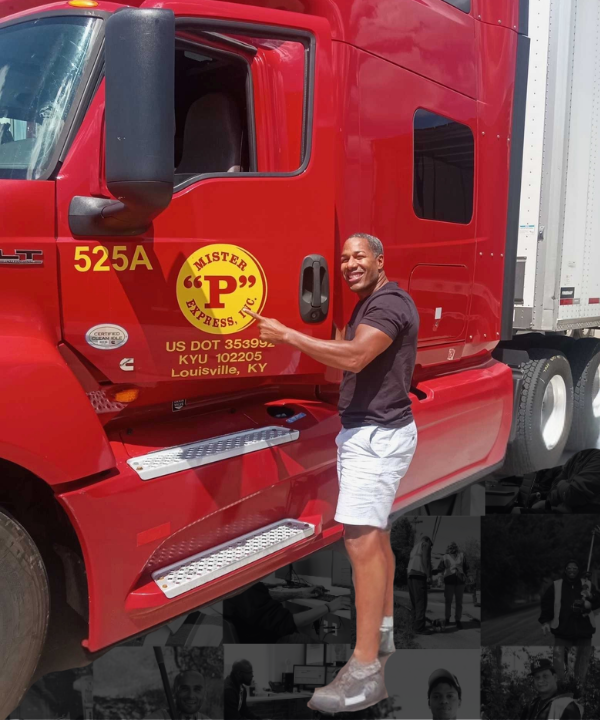
By the time Jerry turned 18, his life in Louisville, Kentucky had already been shaped by poverty and the crack epidemic that swept through his neighborhood. He started selling drugs at 15, was expelled from school for carrying a beeper, and soon after was arrested for robbery. Several state prison sentences followed over the years– a pattern that could have easily defined him.
But inside, Jerry began rewriting his own story. Determined to educate himself and change his life, he earned his high school diploma and became a certified paralegal, but his path veered after hearing stories from his cellmate about driving semi-trucks across the country.
“I’d never been anywhere except for Kentucky,” Jerry says. “As I listened to him tell me about driving through Red Rocks and visiting both oceans and seeing skyscrapers, I realized that my life was half over and I hadn’t experienced any of those things.”
Jerry decided right then and there that when he was released he was going to get a Commercial Drivers License (CDL) and become a long-haul truck driver.
Jerry returned to Louisville determined to build a legitimate life. He found an apartment while on parole and immediately went to a local trucking school. He was referred to the Center for Employment Opportunities (CEO) in Louisville, joined the reentry program for assistance achieving his new dream of working in the trucking industry.
The nonprofit placed him on a transitional work crew cleaning highways for the city. He showed up every day, met with a job coach weekly, and eventually landed a city job in sanitation – a coveted and well-paid position. Although Jerry had a good job, his desire was still set on trucking.
“I had my mind made up,” says Jerry. “Once CEO realized I was serious, they got behind me.”
CEO paid his tuition and a stipend while he attended trucking school full‑time. He passed his CDL permit and road tests, but the next challenge was finding a company willing to hire a first‑time driver with a felony record. After dozens of rejections, one firm took a chance – offering him a job the same day he interviewed.
Two years later, Jerry has driven through 45 states. He’s been swimming in both oceans and has seen skyscrapers for the first time. He drove across the plains and over the Rocky Mountains, landscapes he once only heard about from his cellmate.
“CEO carried me through the door,” Jerry says. “They did something for me that I couldn’t have done myself. I recommend anyone who’s coming home to give them a try…you never know what will happen.
Unfortunately, Jerry’s success doesn’t meet the national norm: nearly 75% of people released from prison remain unemployed a year after their release, according to CEO’s Policy Lab. Yet places like CEO are changing that narrative. A study by the New York Division of Criminal Justice Services, Recidivism, and Employment found that CEO participants are 48% more likely to be employed three years after enrollment than those without support.
The trucking company that hired Jerry gave him a chance when no one else would and gave him the opportunity to prove himself. Now, his next goal is to own his own company and hire other formerly incarcerated drivers.
“I’ll have four trucks in the next three years. It will happen because I’m determined, but I couldn’t have gotten here alone,” says Jerry. “CEO sends me a work retention check every month. They paid for my tuition at trucking school and gave me money for essentials while I was in class and couldn’t work.”
“I owe so much to the staff and participants who encouraged me to keep going. I’d refer anybody to CEO,” Jerry says. “We’re family now.”
